
Journal
The $130,000 net under the Golden Gate Bridge
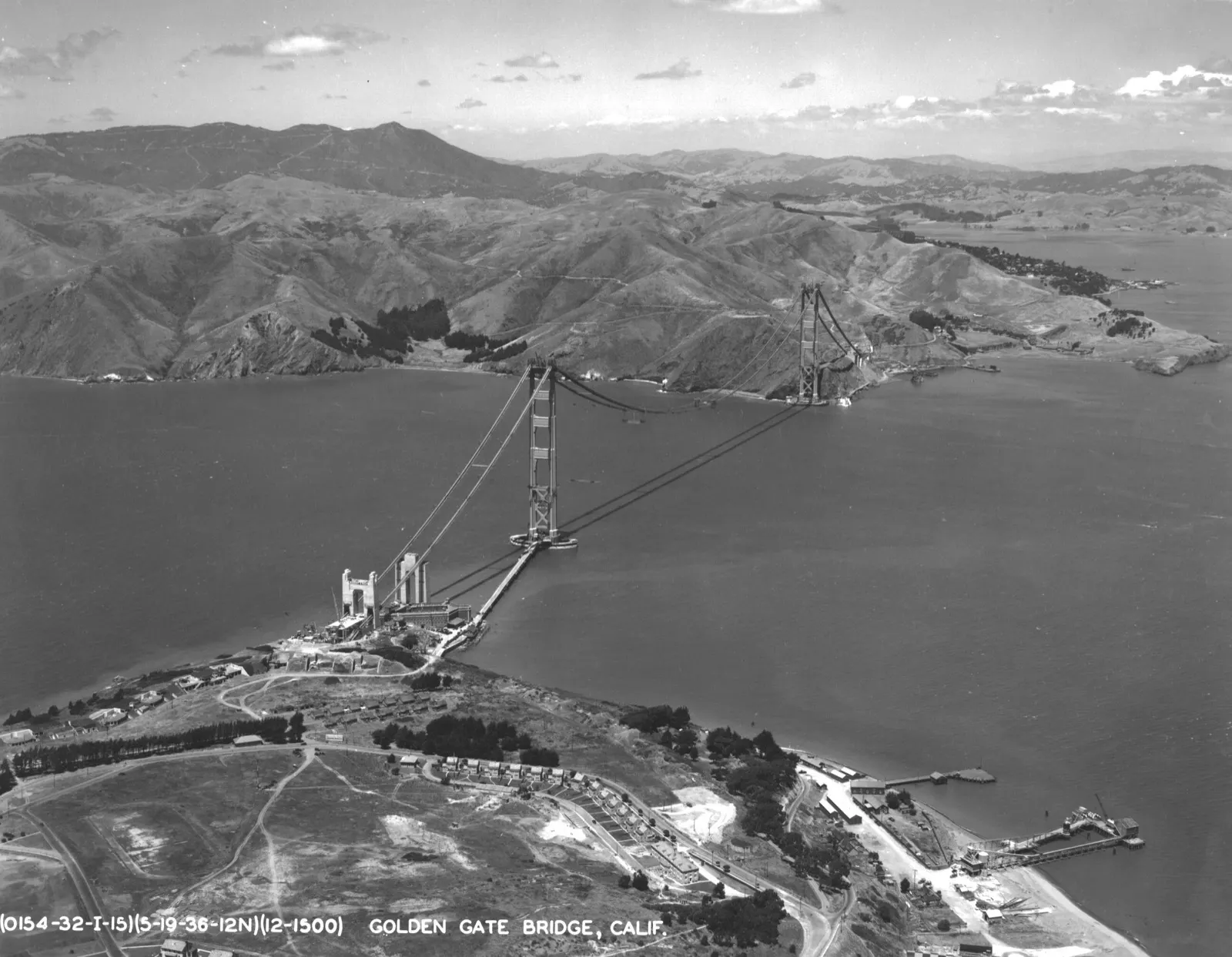
Adapted from a LinkedIn post by our founder, William Beck.
In the 1930s, people who built with high steel had a rule of thumb: one worker dies for every $1 million spent.
The Golden Gate Bridge cost $35 million.
You can do the math. Everyone on the job did too.
The odds
Construction started on January 5, 1933. Men would work hundreds of feet above cold water, in wind and fog, through the middle of the Depression. By the industry's own rule of thumb, a $35 million job meant something like 35 funerals. That was treated as the price of doing business.
The chief engineer, Joseph Strauss, did not accept those odds. He spent money on two things.
Hard hats, enforced
The first was the hard hat. The Golden Gate was not the first big job to use them, but it was one of the first major projects to require them and actually enforce it. Edward W. Bullard adapted the miner's helmet into an industrial hard hat, and Strauss insisted it be worn, under threat of dismissal.
There were other rules too: safety lines, and no stunting on the steel. Stunting at any height was grounds for immediate dismissal. Strauss fired men who were caught doing it.
The net
The second was much bigger. Strauss had a safety net hung under the bridge along the entire length of the span, from tower to tower. It reached ten feet out past the sides of the bridge, so a man who slipped off the edge still had something to land in.
It cost $130,000. In the middle of the Depression, on a project financed by a bond issue that voters had approved, that was not a small line item. It was money spent on something that would only matter on the worst day of someone's life.
Here is what the net got him.
19 men who fell and lived. Nineteen workers went off the steel and landed in the net. They called themselves the Halfway-to-Hell Club.
A new problem. Some workers started diving into the net on purpose, for the thrill. Management had to threaten them with dismissal to make them stop.
The day the net was not enough
It did not save everyone. The first death came on October 21, 1936, when a traveling derrick toppled and killed Kermit Moore.
Then, on February 17, 1937, a section of scaffold carrying twelve men broke loose while crews were removing scaffolding under the deck. It fell through the safety net and took the net with it. Ten men died that day. Two survived. In total, eleven men died building the Golden Gate Bridge.
The bridge opened to pedestrians on May 27, 1937, and to cars the next day.
By the rule of thumb, the job should have cost around 35 lives. It cost eleven, and each of those was a man with a family. But 19 men who should have been on that list went home.
That is what the $130,000 bought.
What it means for a firm today
Strauss did not have a dashboard. He had a rule of thumb that everyone accepted, a number that told him what the job was going to cost in lives, and the nerve to treat that number as something he could change instead of something he had to live with. He put a price on the risk, decided it was worth $130,000 to change it, and then got results he could count, one fall at a time.
Most engineering and construction firms are still run on rules of thumb. What a job should cost, how much rework is normal, how many hours a project manager should spend on reporting, how long it takes to bill. Some of those numbers are right. Some of them are just old. The firms that do well are the ones that measure what is actually happening on their jobs, find the number everyone has stopped questioning, and decide what it is worth to change it. That is the work we do with firms at VisualFlow Analytics: connecting the data that is already there so the numbers can be checked instead of assumed.
Sources
- Golden Gate Bridge Highway and Transportation District, Construction
- Golden Gate Bridge Highway and Transportation District, Frequently asked questions
- Golden Gate Bridge Highway and Transportation District, Key dates
- PBS American Experience, Workers on the Golden Gate Bridge
- National Archives, Aerial photograph of the Golden Gate Bridge being constructed (18-AA-24-18)
About VisualFlow Group
A data, AI and capital group. It started in engineering and construction and works with companies across Canada and the US. About the group
More from the journal
- Over $263M in client operations on our infrastructure: the AUM of data
- Hoover Dam and the $48,890,995.50 bid
- Why we started with engineering and construction
- Advise, Software, Capital: how VisualFlow Group works