
Journal
Hoover Dam and the $48,890,995.50 bid
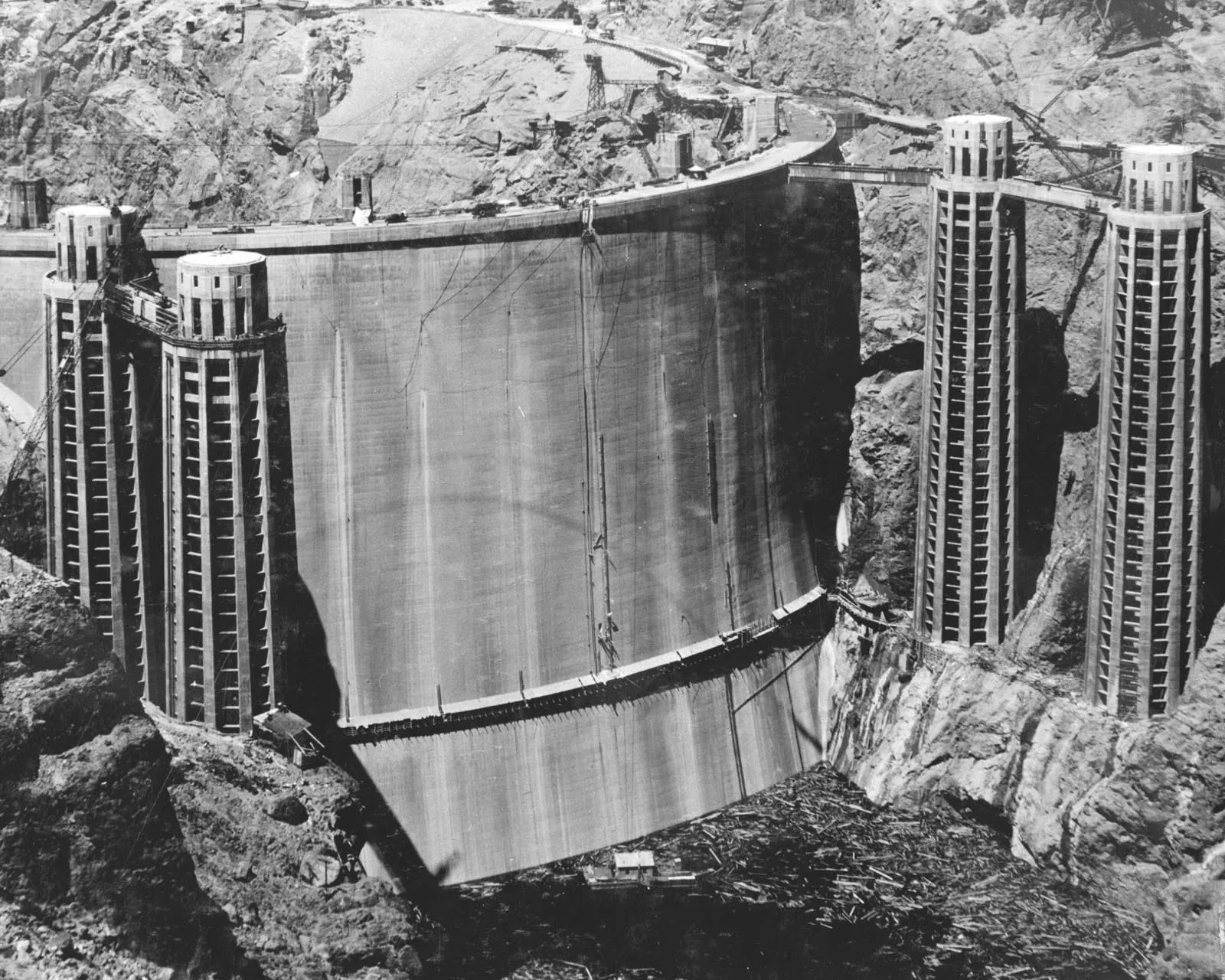
Adapted from a LinkedIn post by our founder, William Beck.
In 1931, the federal government was ready to dam the Colorado River in Black Canyon, and almost nobody could afford to bid on it.
The winning contractor had to post a $5 million performance bond. In the depths of the Depression, that was a risk beyond the means of any one construction company in the country.
So a group of them teamed up.
Six companies, one bid
They called themselves Six Companies. Two of the partners came from the Bay Area: W. A. Bechtel Co. of San Francisco and Henry J. Kaiser of Oakland, who took a joint 30% share. The rest were Utah Construction Co., MacDonald & Kahn, Morrison-Knudsen of Boise, and two Portland firms, J. F. Shea Co. and Pacific Bridge Co. Each partner pledged part of the bond. Shea alone put up half a million dollars.
The Bureau of Reclamation opened the bids in Denver on March 4, 1931. Six Companies bid $48,890,995.50.
Yes, with the 50 cents.
The contract
The terms were simple and unforgiving. The contract gave them 2,565 days, about seven years, from the start of work on April 20, 1931. The job was split into five divisions, and for every day any of them ran late, the contractor owed $3,000.
So they ran the job like their CFO was watching.
How they ran it
They won by $5 million. The next bid, from the Arundel Corporation of Baltimore with Lynn H. Atkinson of Los Angeles, came in at $53,893,878.70. Six Companies was $5,002,883.20 lower. Their number was also just $24,000 below the government's own estimate. They had priced the job almost exactly.
They attacked the biggest line item first. The largest single item in the bid was tunnel excavation: $13,285,000 for 1,563,000 cubic yards of rock. Before the dam could go up, the Colorado River had to be moved around the site through four diversion tunnels cut into the canyon walls. The digging was done by May 23, 1932, about thirteen months after work began. By November 14, 1932, the river was running through the Arizona tunnels.
They carried the cash. The government held back part of every payment until half the work was done. Fortune reported in 1933 that the partners had been $3.5 million out of pocket before money started coming in, and that until the halfway mark they received only ninety cents on the dollar. Moving fast was not only about avoiding penalties. It was how they got paid.
They finished more than two years early. The last concrete went in on May 29, 1935. On March 1, 1936, the Secretary of the Interior accepted the dam, more than two years ahead of the deadline in the contract.
When the books closed, Six Companies had cleared more than $10 million on a contract that change orders had grown to roughly $54.7 million. Close to a fifth of the job, in the middle of the Depression.
Not bad for a group that couldn't cover the bond on its own.
The cost to the men who built it
The money was not the whole story. In August 1931, after Six Companies cut pay for some diversion tunnel workers, the entire work force walked out; the company held the pay cut, the strike ended within days, and living conditions at the site were improved afterward. Reclamation's official count is 96 men killed in industrial accidents building the dam.
What it means for a firm today
Six Companies did not win because they were the biggest contractor in America. None of them were big enough. They won because they knew their numbers. They priced the job $24,000 under the government's own estimate, knew which line item carried the most money, and knew that their cash depended on getting through the work fast. Then they managed the job against those numbers every day.
Engineering and construction firms today have far better tools than a slide rule and a ledger, and most of them still struggle to see their own jobs that clearly. Utilization, work in progress, backlog and billing sit in different systems, and the picture of how a project is really doing arrives weeks late. The firms that win the next big pursuit, or survive the next bad year, will be the ones that can see their margins while there is still time to act on them. That is what we work on with firms at VisualFlow Analytics.
Sources
- C. H. Vivian, "Construction of the Hoover Dam," 1931, Bureau of Reclamation clipping archive
- Wm. Joe Simonds, Hoover Dam: The Boulder Canyon Project, Bureau of Reclamation
- Bureau of Reclamation, Diversion tunnels FAQ
- Bureau of Reclamation, Fatalities at Hoover Dam
- Fortune, September 1933, reprinted by the Bureau of Reclamation
- PBS American Experience, The Six Companies and The workers' strike
- Financial History magazine, no. 137, 2021, Hoover Dam
- Bureau of Reclamation photograph WASH-No-3146, via Wikimedia Commons

About VisualFlow Group
A data, AI and capital group. It started in engineering and construction and works with companies across Canada and the US. About the group
More from the journal
- Over $263M in client operations on our infrastructure: the AUM of data
- Why we started with engineering and construction
- Advise, Software, Capital: how VisualFlow Group works
- VisualFlow Group, VisualFlow Analytics, VisualFlow Analytics LLC and VisualFlow Cloud: how the group is organized